Jimmy Eat World: The Mesa Band That Paid Its Own Way to "The Middle"
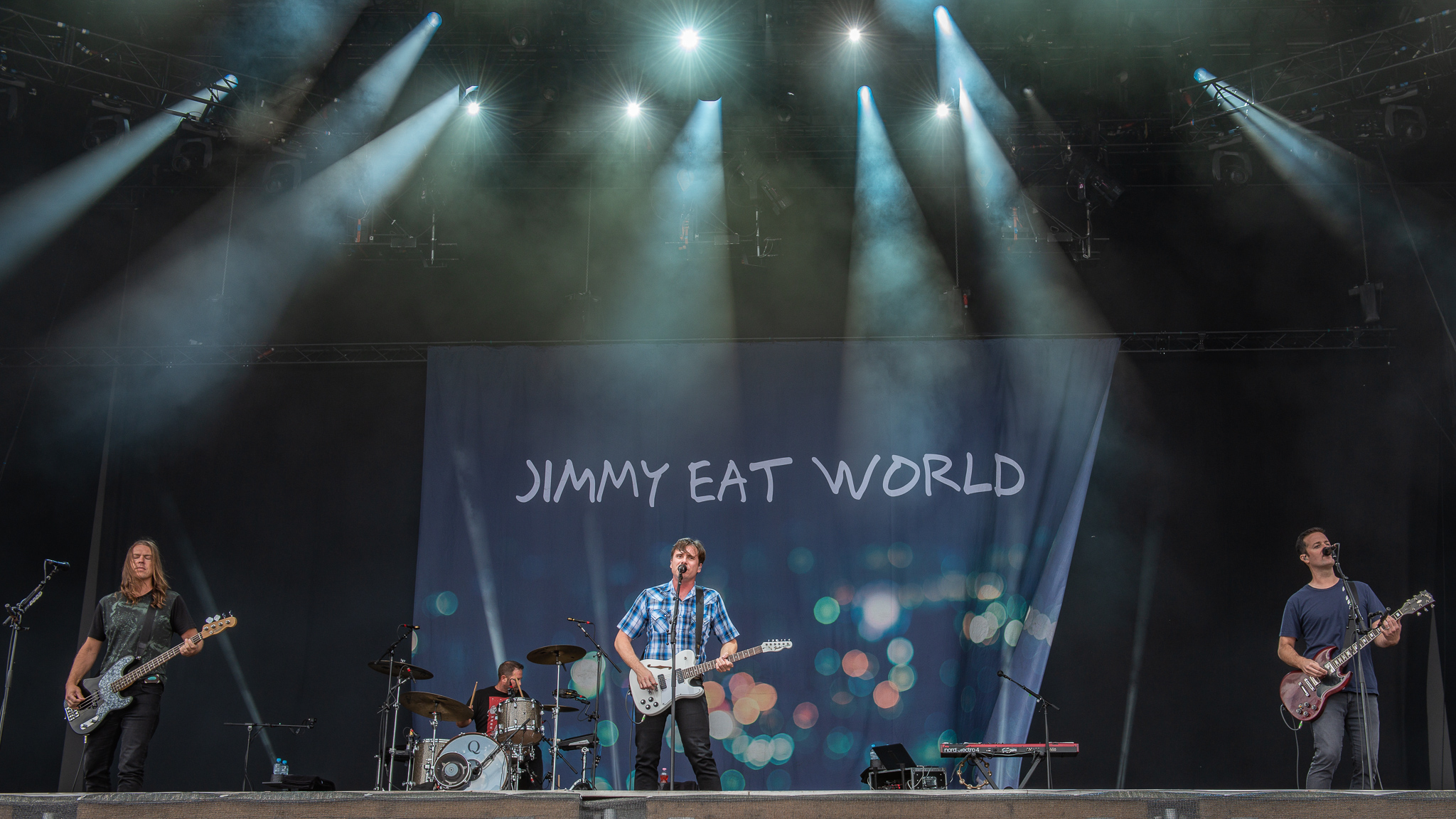
Photo: Stefan Brending (2eight) / Wikimedia Commons, CC BY-SA 4.0 (https://creativecommons.org/licenses/by-sa/4.0/). Source: https://commons.wikimedia.org/wiki/File:2018_RiP_-_Jimmy_Eat_World_-_by_2eight_-_8SC8102.jpg
Jimmy Eat World got their name from a drawing. According to Wikipedia and the Arizona Republic, guitarist Tom Linton's younger brothers Jim and Ed fought a lot, and Jim usually won. Ed got his revenge by drawing Jim shoving the Earth into his mouth and captioning it "Jimmy eat world." Three decades and ten albums later, the band from Mesa, Arizona has 7,010 plays on U-Rock®.
Friends since preschool
Wikipedia says the band formed in Mesa in 1993. Frontman Jim Adkins and drummer Zach Lind had been friends since preschool, and they teamed up with Linton and bassist Mitchel Porter. They started out as a punk rock band, released a demo tape in 1993 and the EP One, Two, Three, Four in 1994. Their self-titled debut album came out the same year with Linton singing most of the lead vocals. Early influences included pop-punk bands Mr. T Experience, Radon and Horace Pinker.
Bands like Sunny Day Real Estate then pushed them toward slower tempos and more varied song structures. On tour in the indie scene they found kindred spirits in Christie Front Drive, Sense Field and Seven Storey Mountain. Capitol Records signed them in mid-1995. Just before that, Porter was replaced on bass by Linton's friend Rick Burch, completing the line-up that has played on every album since.
Static Prevails and Clarity
With producer Mark Trombino, Wikipedia says, the band made its major-label debut Static Prevails, with the singles "Call It in the Air" and "Rockstar." Unhappy with Capitol, they still owed the label another record. They made Clarity in 1998–99, the album where Adkins became the main lead vocalist. It included "Lucky Denver Mint," which was remixed for the film Never Been Kissed, and closed with "Goodbye Sky Harbor," based on John Irving's A Prayer for Owen Meany. Wikipedia notes that Clarity was overlooked at the time but has since gained cult status and critical acclaim.
Bleed American, on their own dime
Then came the gamble. Wikipedia, SPIN, Louder and the Los Angeles Times all say the band recorded their next album without a label, paying for it with touring, a singles compilation and day jobs. Trombino agreed to be paid later; SPIN says he worked "pretty much for free." Louder reports Adkins remembering Linton sitting in a bar clutching a backpack holding $35,000, because they couldn't leave it in the car or deposit it all at once. The Los Angeles Times says they earned recording money working construction and selling art supplies and auto parts. Adkins described the goal as "writing and playing the most precise, simple pop rock possible." The result was Bleed American, released by DreamWorks in July 2001. "The Middle" reached No. 5 on the Billboard Hot 100 and topped the Alternative Songs chart, and its video was all over MTV's Total Request Live. The album went platinum. After the September 11 attacks, the band reissued it as Jimmy Eat World in case the title was misread. A 2008 deluxe edition restored the original name.
Futures and beyond
For 2004's Futures they brought in producer Gil Norton, known for his work with Pixies and Foo Fighters. Lind said the songs written after they left the sessions with Trombino, "Polaris," "Work," "Pain" and "23," "really gave Futures its heartbeat." Wikipedia reports that "Pain" became another No. 1, and the album went gold. When DreamWorks closed, the band moved to Interscope, and in 2005 they toured with Green Day. Chase This Light (2007) became their highest-charting album, reaching No. 5 on the Billboard 200. Their tenth album, Surviving, came out in October 2019.
Why it matters on U-Rock®
Jimmy Eat World's biggest record happened because they bet on themselves: day jobs, deferred fees and no label until the songs were done. That's the U-Rock® spirit at platinum scale. With 7,010 plays, they're a fixture on our airwaves.
U-Rock® play data: 7,010 plays logged across the BROADCAST and CORE histories (2026-07-02 to 2026-10-12), using the higher of the two logs.
Sources 1. Wikipedia, "Jimmy Eat World" — https://en.wikipedia.org/wiki/Jimmy_Eat_World 2. U-Rock® BROADCAST (AzuraCast) and CORE (airplay_spins) play logs 3. Arizona Republic (azcentral), "25 years of Jimmy Eat World" (2019) — https://www.azcentral.com/story/entertainment/music/2019/07/26/how-jimmy-eat-world-became-biggest-arizona-rock-band-century/1801623001/ 4. Louder, "Jimmy Eat World: the story behind Clarity and Bleed American" — https://www.loudersound.com/music/albums/jimmy-eat-word-clarity-bleed-american-story-behind-album 5. Los Angeles Times, "Jimmy Eat World on 25 years of 'Bleed American'" (22 Jul 2026) — https://www.latimes.com/entertainment-arts/music/story/2026-07-22/jimmy-eat-world-on-25-years-of-bleed-american 6. SPIN, "Jim Adkins Looks Back at 'Bleed American' at 20" (Jul 2021) — https://www.spinmagazine.com/2021/07/jimmy-eat-world-bleed-american-jim-adkins-interview-20th-anniversary/
