
The Guitar Becomes the Canvas
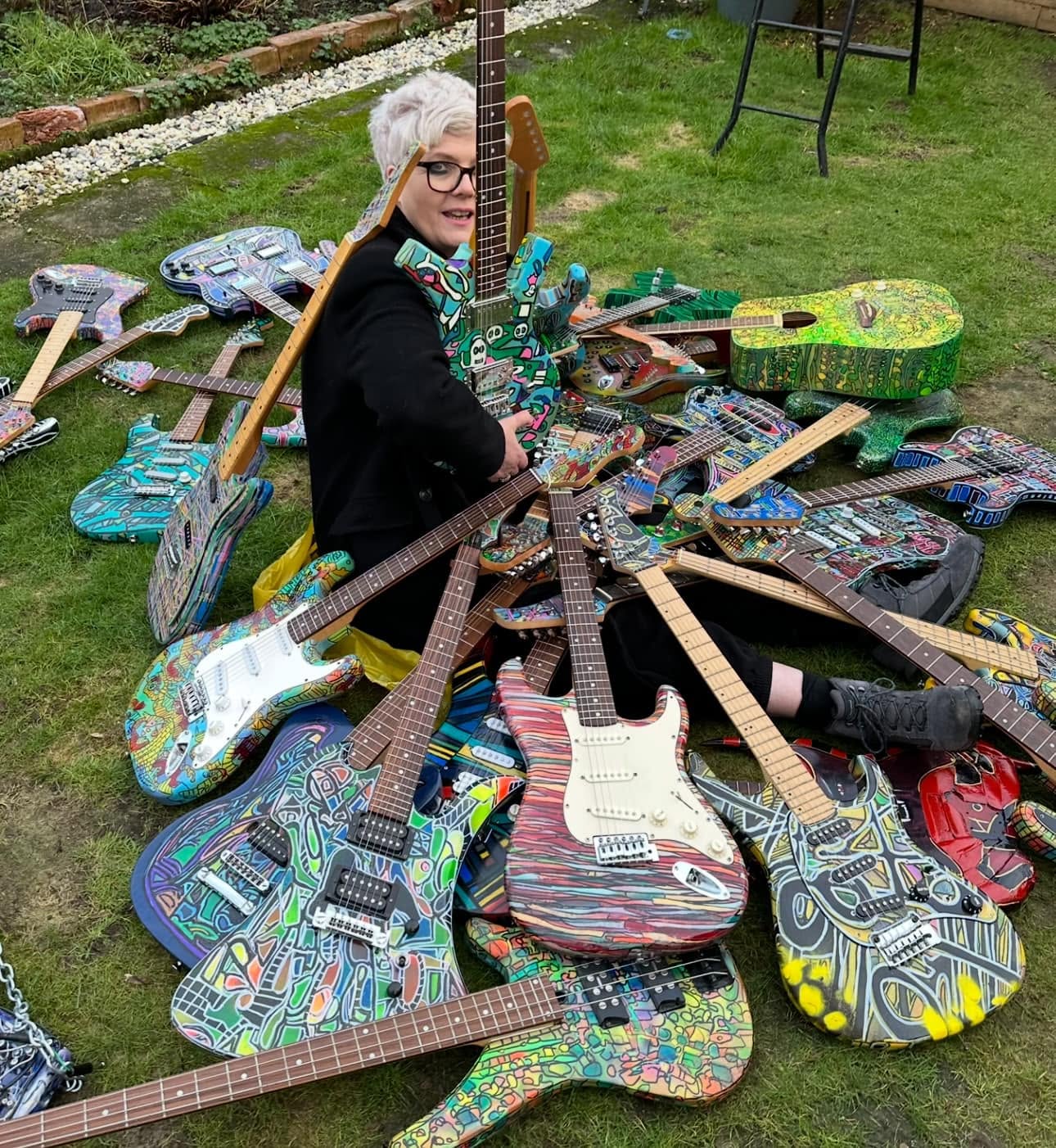
There are guitars you play.
There are guitars you collect.
Then there are guitars that stop the scroll.
Jennifer Armstrong works in Glasgow, signs the work JPAX, and treats the electric guitar as a canvas that still has to survive a strap, a cable, and a stage. Tele bodies, Strat shapes, Flying Vs, Les Paul copies, Jacksons, Westfields, pickguards, basses. One design. One pair of hands. No factory run.
She has said it plainly: she is happy when she is making something. In a late-2024 workshop interview she explained the name itself — JPAX — as a signature she could live with after "Jennifer Armstrong" felt too long, tied to a puppy named Pax and the idea of peace. Before the guitars, she painted portraits and the faces she loved: Debbie Harry, Alice Cooper, Frank Zappa. Around 2018 she made a Zappa guitar and wanted to keep going. Wiring was the missing piece. Friends in Scotland — she names Malcolm, "Malko," as the tech who rebuilds instruments — made the work playable again.
That is the U-ROCK® point. She is not slapping a decal on a wall-hanger. She strips finishes when she has to, paints for days, lacquers, then sends the body back into the world as an instrument. In her own posts she has said some pieces take twenty or thirty or forty hours. She has also said, without romance, that the money from painted guitars pays bills and supplies. She paints what she can afford to paint.
The work travels. A guitar went to Taiwan. Bodies keep landing in the United States. In March 2026 she posted that Timothy in the US received a JPAX Tele body and was already planning the build. Players keep the necks and pickups they trust and drop a JPAX guard or body onto the instrument they already love.
There is a rock connection that belongs in the story if it is labeled correctly. On her own Instagram she captioned a Japanese body as belonging to Elwood Francis of ZZ Top: Christmas present from his wife, he built it, she painted it. Francis is the bassist who stepped in after Dusty Hill. That caption is hers. Until Francis or the band confirms it on their side, U-ROCK® runs it as the artist's account, not as a press-kit fact.
The market moment that is on the public record happened in Montana. For Jazzoula 2026 at the Zootown Arts Community Center, organizers staged the first Missoula Guitar Show — Montana luthiers in the gallery by day, music at night. Closing-night raffle centerpiece: a custom Telecaster hand-painted by Jennifer Armstrong of Scotland, listed at $2,200, proceeds to Jazzoula. Glasgow paint on a Montana stage. That is the independent circuit working.
Musicians have always marked instruments. Harrison's Rocky. Clapton's Fool. Van Halen's stripes. Usually the player gets there first and the scars become the story. Armstrong reverses the order. The artwork is intentional before the first gig. The silhouette of the guitar is part of the composition. Then somebody plugs it in and the painting gets a soundtrack.
She has said she often has dozens of painted instruments ready and a much larger pile waiting. She has also said she should probably stop and that she would go crazy if she did. That is not a brand deck. That is a working artist.
U-ROCK® is not here to manufacture a celebrity painter. We are here because an independent Glasgow artist found a form, kept making it, and the work crossed an ocean without a product committee. One guitar. One artwork. No duplicate.
When a musician takes a JPAX onstage, two jobs finish at once: she decided what it looks like. They decide what it sounds like.
That is the feature. Interview is the sequel.
— U-ROCK® Network
